
The work of Leonardo da Vinci is a timeless source of inspiration and study for students across disciplines, whether in art, engineering, or science. His works have inspired countless interpretations that one of the most controversial being The Da Vinci Code, which sparked global debate and fascination. In 1994, Bill Gates purchased the Codex Leicester, a manuscript by Leonardo da Vinci, for $30.8 million. Bill Gates as one of the wealthiest individuals in the world, acknowledged the weight of Leonardo da Vinci’s legacy. In his review of Walter Isaacson’s biography Leonardo da Vinci, Gates shared that after winning the bid for the Codex, he broke with tradition:
“After I won the bid, I broke a longstanding tradition. I was supposed to change the name from Codex Hammer (the previous owner was the industrialist Armand Hammer) to Codex Gates, but I thought that sounded silly and I changed the name back to Codex Leicester, the name it held from 1719 until 1980.”
This story speaks volumes: not even a billionaire could justify changing the name of a manuscript authored by a genius whose legacy transcends wealth.
This blog is both a tribute to Leonardo da Vinci’s extraordinary legacy and a record of my personal journey exploring his remarkable works.
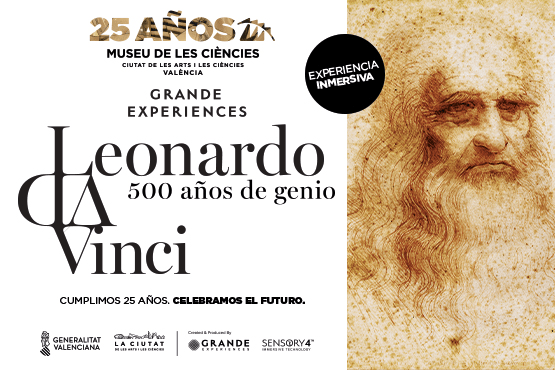
LEONARDO DA VINCI. 500 YEARS OF GENIUS
Located in the Science Museum in Valencia, the Leonardo da Vinci exhibition awaits just one floor above the ticket counter. As you enter, your child might dash straight to the Metamorphosis section, a space designed especially for kids, featuring interactive experiments on topics like vision and magnetic fluids.
Beside it, you’ll find something extraordinary: a temporary exhibition titled “Leonardo Da Vinci: 500 Años de Genio.” If you’re in Valencia during spring 2025, consider yourself fortunate, this is a rare opportunity. The exhibition is not permanent; you might not find it in the winter, nor is it guaranteed to appear in another country anytime soon. And even when similar events are held, they often present only immersive digital visuals of da Vinci’s art, great for photos, but lacking the depth of his true work.
Who knows if there will be a celebration for the 501st anniversary? It could be another 10 or 20 years before such an exhibition returns. My message is simple: if you ever find yourself near a real Leonardo da Vinci exhibition, go. It’s a rich, intellectual experience one that brings you closer to the genius who blended art, science, and imagination like no other.
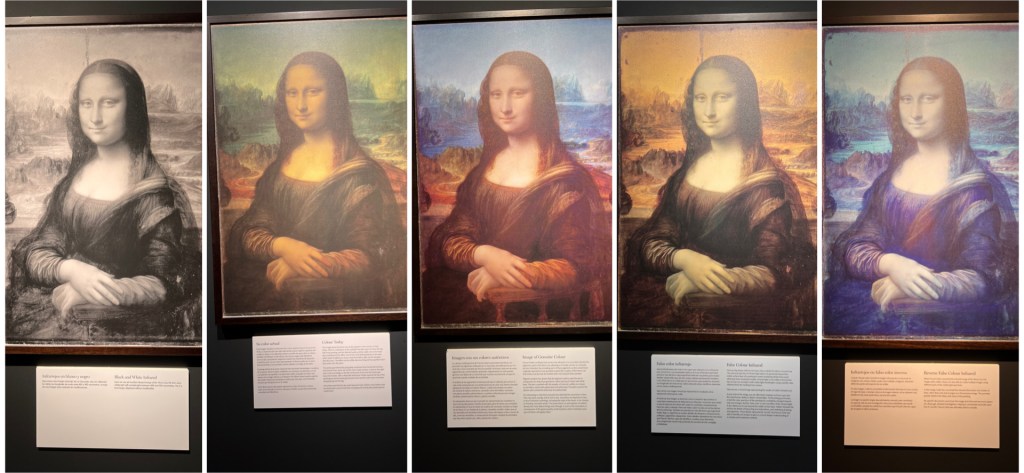
Monalisa True Color
One of the most intriguing sections of the exhibition is dedicated to the Mona Lisa: undoubtedly Leonardo da Vinci’s most discussed painting, captivating both mathematicians and art students alike. The precise rendering of facial muscles and the symmetrical composition are often associated with the golden ratio, sparking countless interpretations from viewers around the world. Over time, exposure to sunlight, humidity, and natural aging has altered the painting’s colors, making them different from what Leonardo originally intended. In the exhibition, researcher Pascal Cotte attempts to reconstruct the painting’s original colors using a technique called Reverse False Color Infrared imaging. This method reveals that areas now dark may have once been blue. Another layer of false color infrared imaging allows us to see beneath the surface, uncovering hidden details such as retouching, restorations, and even underlying sketches and pigments. Ultimately, these insights help us glimpse the true colors of the Mona Lisa as envisioned by Leonardo himself.
INSIDE A GENIUS MIND
If you can’t make it to the “Leonardo da Vinci: 500 Years of Genius” exhibition, there’s good news: his brilliance is just a click away. Inside A Genius Mind is an interactive visual experience that brings Leonardo da Vinci’s inventions to life, using sketches from his codices. It offers a unique way to explore his genius through digital demonstration, right from your screen.

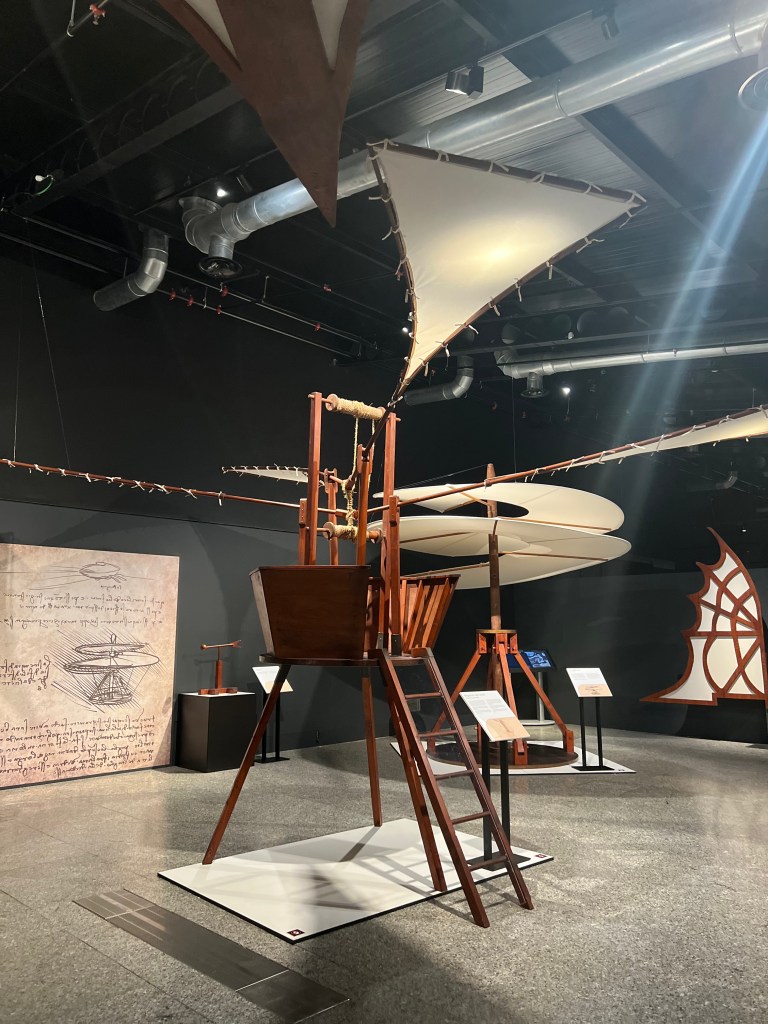
Leonardo da Vinci’s genius in mechanical engineering is evident through his visionary sketches, many of which explored concepts far ahead of their time. Among his most intriguing works are designs related to perpetual motion drawn around the early 1500s which the centuries before formal theories of motion, such as torque and force, were fully developed and popularized in the 1800s. Without the benefit of modern scientific language or tools, Leonardo intuitively grasped mechanical principles that would later become foundational in classical mechanics. His ability to visualize complex systems and mechanical interactions highlights not only his inventive spirit but also his extraordinary natural intellect that pioneered art, science, and engineering in a way unmatched in his era.
There are thousands of facets to Leonardo da Vinci’s work worth studying, and what we understand today may evolve with future discoveries. Sometimes in ways that are surprising, inspiring, or even disappointing. Nonetheless, for anyone interested in art, engineering, biology, religion, or architecture, Leonardo’s body of work remains an enduring and rich source of knowledge. His ability to bridge disciplines makes his legacy relevant and valuable to every generation seeking to understand the world through creativity and curiosity.
 A Cup of Think